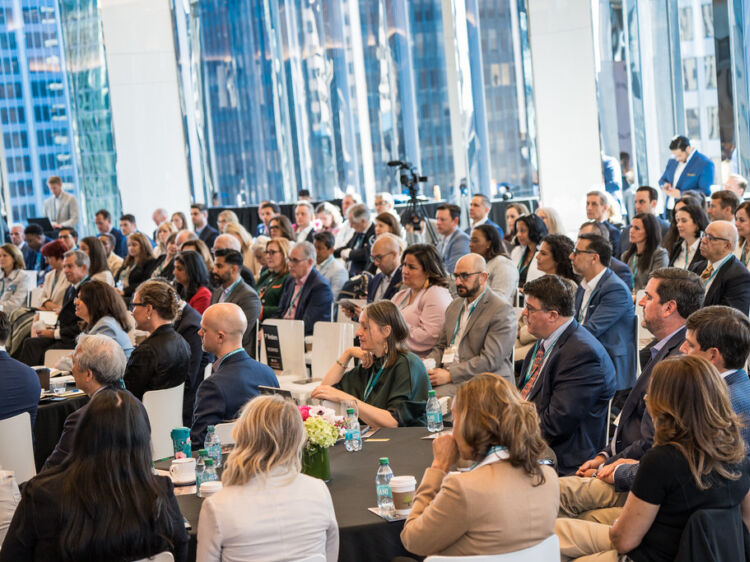
Rethinking Leadership in Disruptive Times
By Amy Reid, Managing Partner
Executive Search, Royer Thompson
Reflections from the AESC Global Summit on Leadership
At this year’s AESC Global Summit on Leadership in New York City, one message I heard consistently across conversations with global executives, investors, and leadership advisors:
The role of the CEO is fundamentally changing.
Disruption is no longer episodic. It is continuous. At the same time, emerging technologies are accelerating how information is synthesized, decisions are shaped, and organizations compete.
The pace of adoption alone is notable. According to McKinsey’s 2025 global AI survey, 78% of organizations now report using AI in at least one business function, up significantly from prior years. PwC estimates AI could contribute up to $15.7 trillion to the global economy by 2030, while Microsoft’s Work Trend Index continues to show leaders are facing increasing pressure to process larger volumes of information, make faster decisions, and lead through continuous disruption.
What became increasingly clear throughout the conference was that this is not fundamentally a conversation about technology.
It is a conversation about leadership capacity.
About how executives absorb complexity, process information, make decisions under pressure, and lead organizations through continuous change.
One of the most compelling sessions at the conference featured AESC CEO James Edmund Datri in conversation with Misha Logvinov, a technology investor and operator working at the intersection of global AI infrastructure, capital investment, and emerging technologies through his role with MGX.
What stood out was not the technology itself, but what it is revealing about leadership.
The strongest leaders are not outsourcing judgment.
They are using emerging tools to strengthen research, accelerate synthesis, and sharpen decision-making.
The competitive advantage is increasingly tied to leaders who can:
- Ask better questions
- Interpret outputs critically
- Apply judgment and context
- Translate insight into action
The discussion also reinforced that productivity expectations are already shifting. Leaders are operating in environments where speed, responsiveness, and decision-making capacity are being redefined in real time.
That pressure is showing up globally. Deloitte’s 2025 Human Capital Trends report found that executives increasingly view adaptability, learning agility, and human-centered leadership as critical differentiators in a workforce being reshaped by automation and disruption.
Another theme that resonated strongly was curiosity.
Continuous learning is quickly becoming a baseline leadership capability. The risk is no longer simply a lack of technical expertise. Increasingly, it is executive disengagement.
One memorable moment came when Misha connected leadership to mountaineering, a personal passion involving high-risk climbs around the world. His point was simple: leaders who develop perspective beyond work often make stronger decisions within it.
Navigating uncertainty, reassessing risk in real time, and making disciplined decisions under pressure are increasingly defining modern leadership.
The organizations that pull ahead will not necessarily be those with the newest tools or the loudest innovation narratives.
They will be the ones with leadership teams capable of navigating ambiguity, learning continuously, applying sound judgment, and adapting faster than the pace of disruption around them.
Technology may be accelerating change.
But leadership remains the differentiator.
Because in the end, this is not simply a technology conversation. It is fundamentally a leadership one.
Sources and Further Reading
Executive Search Consultants and Top Executive Search Firms | AESC